Three hundred supplier agreements, and
the inbox is the system of record
A governed contract workflow gives procurement and legal one place to see what was sent, what came back changed, who approved it and when it expires.
ENTERPRISE CONTEXT AT A GLANCE
300
suppliers under agreement
5
agreement categories
1 · 2 · 5 yr
tenures, in differing formats
20–30
agreements in negotiation at any time
ON THIS PAGE
01
Enterprise context
A large multi-plant manufacturer works with roughly 300 suppliers under five agreement categories: non-disclosure, proprietary, electrical, mechanical and others. Tenures run one, two or five years, in differing formats. At any time, 20 to 30 agreements are in negotiation.
02
The challenge
Standard documents go out by email and supplier versions come back by email. Those versions can depart from standard terms, and there is no systematic deviation report or check of whether a clause favours the buyer. Legal approvals, senior-management approvals and supplier queries run through the same threads. There is no single repository, no consolidated view of pending versus approved agreements, no automated expiry reminder, and no way to compare agreements of one type across suppliers or a part family.
03
Why it matters
Everything above was stated by the customer. The implications below are our inference.
Implication 1
A deviation nobody flagged becomes a term the business has accepted.
Implication 2
Terms already won from one supplier cannot inform the next negotiation if nobody can find them.
Implication 3
Legal and procurement time goes to locating documents and chasing status, not judging terms.
Implication 4
An agreement that lapses unnoticed leaves supply running without current cover.
04
How Orbis addresses it
Orbis Vendor & Contract Management is designed to treat an agreement as a tracked commitment, not an attachment. Each one moves through visible stages, so the 20 to 30 in flight can be read in one view. AI assists drafting and review: it reads the supplier’s version against standard terms, highlights deviations and commercial risk, and routes exceptions to legal. Approvers decide, and Orbis records who approved what and why. Signed agreements carry their obligations forward, such as a renewal notice ahead of expiry.
WORKFLOW IN ORBIS
1
Drafted
2
Legal
3
Procurement
4
Signed
05
In Orbis
ELEMENT
IN ORBIS
Module
Vendor & Contract Management
Workflow transformed
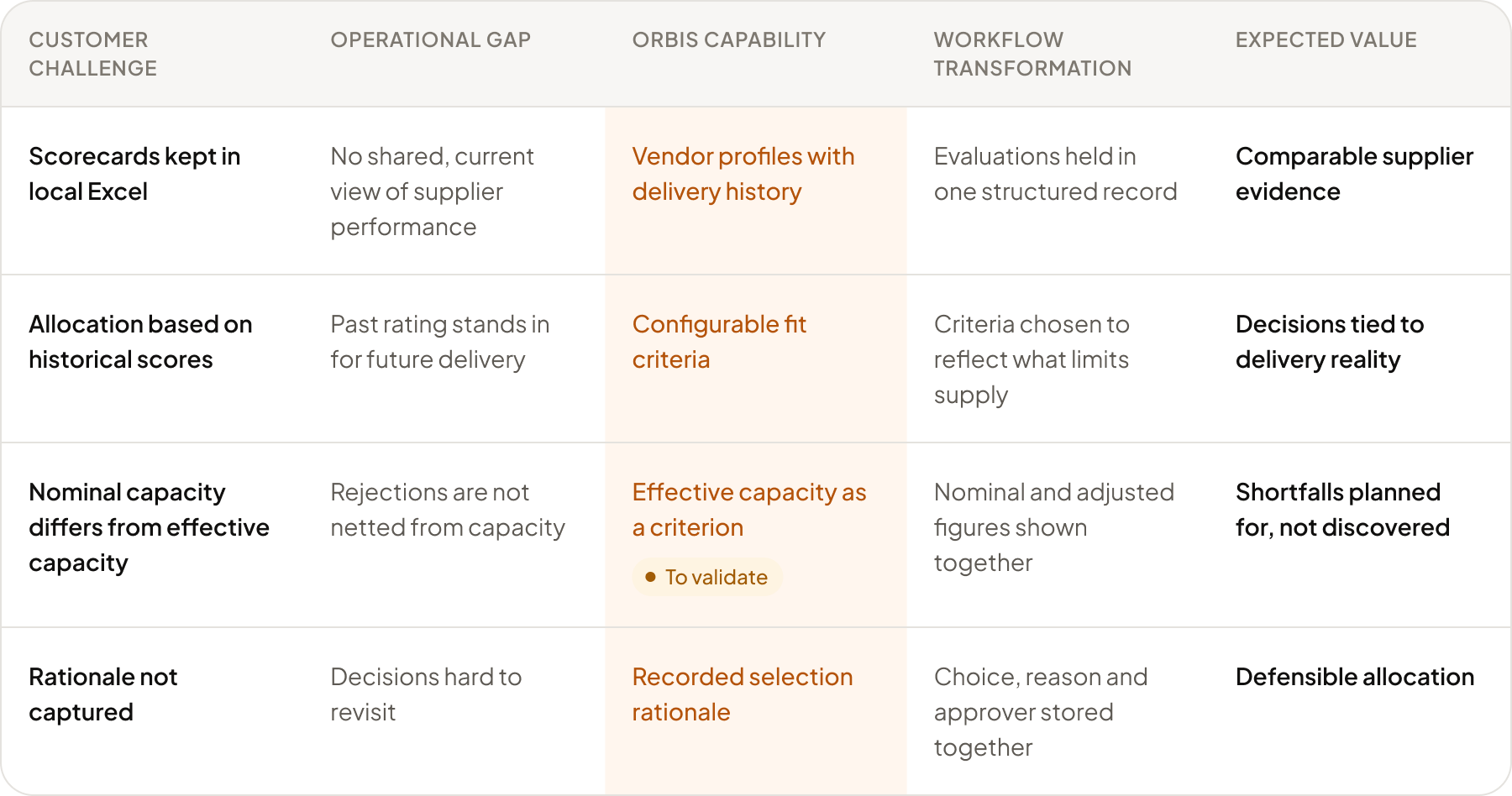
Scorecard lookup in spreadsheets becomes a structured vendor evaluation with recorded decision
Information connected
Vendor profiles, delivery history, fit criteria, the requirement being sourced, decision rationale
AI assistance
Suitable-vendor identification; commercial and delivery risk highlighting
Automation
Side-by-side comparison against configured criteria
People decide
Business owners select; procurement and vendor management stay accountable
Dependencies
Quality and rejection data from the customer’s quality or ERP systems; agreed scoring criteria and weights
06
Expected business value
Orbis Vendor & Contract Management is designed to treat an agreement as a tracked commitment, not an attachment. Each one moves through visible stages, so the 20 to 30 in flight can be read in one view. AI assists drafting and review: it reads the supplier’s version against standard terms, highlights deviations and commercial risk, and routes exceptions to legal. Approvers decide, and Orbis records who approved what and why. Signed agreements carry their obligations forward, such as a renewal notice ahead of expiry.
Operational control
One evaluation record per supplier decision, not a file per buyer.
Decision quality
Carry the approved baseline into delivery and track deliverables, effort and cost against it.
Financial visibility
The cost of a capacity shortfall is considered before commitment.
Accountability
The reason a supplier was chosen stays attached to the choice.
CLOSING
A supplier’s score describes the past. A sourcing decision commits the future. Orbis is designed to keep the evidence behind that commitment in front of the people making it.
07
Problem to solution
Explore
every story
Filter by Orbis module to find the challenge closest to yours.
Case 01
Vendor & Contract Management
Three hundred supplier agreements, and the inbox is the system of record
300
suppliers, 20–30 agreements in flight
Get in touch
Our team will get back to you as soon as possible.
Get in touch
Our team will get back to you as soon as possible.
Get in touch
Our team will get back to you as soon as possible.