As featured in Technology Magazine, Procurement Magazine & AI Magazine
How Toyota & Ascentt reimagined the grand vision approach
Most enterprise AI transformations begin with a boardroom slide and a nine-figure ambition. They end two years later with a war-room full of consultants, a platform nobody adopted, and planners still pulling numbers from spreadsheets. Toyota Motor North America saw the pattern. When it set out to modernize demand planning across its global supply chain, the instinct to build a sweeping multi-year programme was there and it was rejected.
Instead, Toyota partnered with Ascentt to do something fundamentally different: start small, start sharp, and let the platform earn its architecture through real operational evidence. That choice and the results it produced are now featured across Technology Magazine, Procurement Magazine, and AI Magazine as a new playbook for enterprise AI on a global scale.
“It always starts the same way for us, A specific problem, not a grand vision. Find a decision that, made faster or better, compounds across the operations. Build for that. Measure. Then build the next one.”
— Nilesh Vyas, CEO, Ascentt
Enterprise AI Use Cases That Transformed Toyota’s Demand Planning and Supply Chain Operations
Our partnership with Toyota North America began by solving a single business problem. After demonstrating measurable value, the approach was repeated across additional challenges. Each initiative delivered clear business outcomes and built organizational confidence in AI. Over time, these targeted successes became the foundation for a scalable enterprise-wide transformation.
1. Extended Long-Range Forecasting:
One of Toyota’s key challenges was limited forecasting visibility. Demand planning teams could only forecast up to three months ahead, restricting their ability to align procurement, production, and inventory decisions with long-term market demand.
We implemented an AI-powered long-range forecasting solution that extended Toyota’s planning horizon to 52 weeks. By leveraging advanced predictive analytics and demand forecasting models, Toyota gained year-long visibility into demand patterns, enabling more strategic supply chain planning, procurement optimization, and inventory management.
Business Impact:
- Forecasting horizons expanded from 3 months to 52 weeks
- Improved long-term supply chain planning
- Enhanced procurement and inventory decision-making
2. Customer value–driven forecasting
Traditional forecasting models often rely heavily on historical sales data, making it difficult to capture changing customer preferences and emerging market trends.
To address this, we introduced an AI-driven forecasting approach that integrates customer demand signals, behavioral trends, and market indicators into the planning process. By focusing on what customers are likely to buy, not just what they bought in the past, Toyota was able to generate more accurate demand forecasts across regions and vehicle models.
Business Impact:
- Forecast accuracy improved by 5–10%
- Better alignment between customer demand and inventory planning
- Increased responsiveness to changing market conditions.
3. AI-powered demand planning intelligence
Demand planners often work across multiple disconnected systems, making it difficult to spot bottlenecks before they impact operations. Allocation conflicts, fragmented demand signals, and planning gaps frequently remain hidden until they create fulfillment challenges.
We implemented an AI-powered demand planning layer that provided end-to-end visibility across planning workflows. The solution proactively identified hidden bottlenecks, surfaced operational risks, and enabled planners to resolve issues before they affected supply chain performance.
By shifting from reactive planning to proactive decision-making, Toyota significantly improved planning efficiency and operational resilience.
Business Impact:
- Early identification of demand planning bottlenecks
- Proactive resolution of allocation and fulfillment risks
- Improved supply chain visibility and decision intelligence
How Agentic AI Scaled Toyota’s Global Demand Forecasting Platform?
The three AI use cases delivered more than short-term business results. They became the foundation for Toyota’s Global Demand Forecasting (GDF) platform. By unlocking siloed data and improving forecast accuracy, each initiative proved that AI could create measurable operational value at scale.
Today, GDF is being deployed across Toyota’s global operations and expanding beyond demand planning into manufacturing, quality management, and supplier collaboration.
Powered by Agentic AI, the platform continuously evaluates demand and supply signals through its Demand Allocation and Reapportion Agent. It identifies potential imbalances early and recommends actions before they impact fulfilment. Generative AI helps planners understand complex forecasting outputs by turning them into clear business insights and recommendations.
The result is a scalable AI-powered forecasting platform that supports faster decision-making, improves supply chain agility, and drives enterprise-wide transformation.
How Ascentt’s AI Strategy Supported Toyota’s Transformation Framework?
Toyota North America’s AI transformation was built around three guiding principles: People, Platform, and Performance. Ascentt aligned its transformation strategy with these priorities from day one. The focus was simple. Deliver business value quickly, create a foundation that could scale, and ensure AI became a practical tool for everyday decision-making across the organization.
| HOW MICRO-TRANSFORMATION MAPS TO TOYOTA’S FRAMEWORK | |
| PEOPLE | Every AI solution was embedded into the tools planners already used. No rip-and-replace, no new interface to learn, no change management battle. AI came to people not the other way around. |
| PLATFORM | GDF was not designed on a whiteboard. It emerged from three production deployments that proved what the architecture needed to do. That lineage made regional rollout far smoother than a blueprint-first platform would have achieved. |
| PERFORMANCE | Metrics were present from week one: forecast accuracy, planning cycle time, throughput. There was never a “we’ll measure impact later” moment. Each use case earned its continuation by demonstrating results in the operation. |
Why Micro-Transformation Is the Future of Enterprise AI Success?
Many enterprise AI initiatives struggle because they attempt to solve too many problems at once. Large-scale transformation programs often require significant upfront investment, lengthy implementation cycles, and extensive organizational change before delivering measurable value.
Our micro-transformation approach takes a different path. Rather than pursuing a broad platform vision from day one, it focuses on solving high-impact business decisions incrementally. Each AI use case is designed to deliver measurable outcomes, validate adoption, and create a foundation for the next stage of transformation.
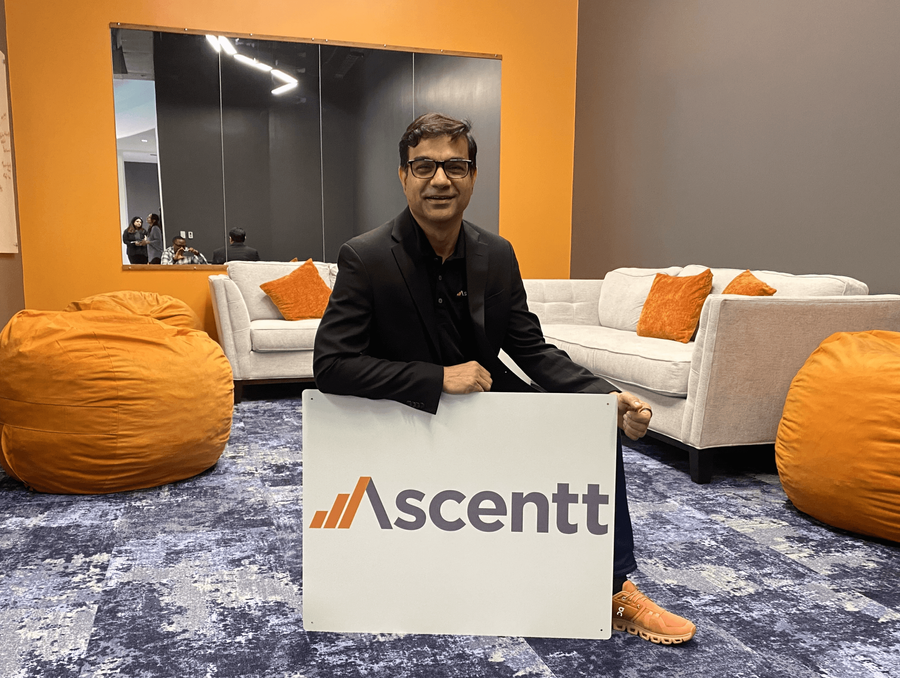
Nilesh Vyas, Ascentt’s CEO developed this methodology after observing a common pattern across enterprises: organizations achieve greater success when AI is implemented through a sequence of targeted, outcome-driven initiatives rather than a single large-scale rollout.
The result is a scalable enterprise AI platform built on proven business value, trusted by users, and refined through real-world operational success. Instead of investing in transformation first and seeking value later, organizations generate value first and scale transformation with confidence.
“Make micro-transformation the way Toyota deploys AI on a global scale. Not as a one-time programme, but as a repeatable operating capability. Start with the mission. Build for production scale. Measure. Move to the next tone, while orchestrating all micro solutions to work together”
— Nilesh Vyas, CEO, Ascentt