Four patterns we keep finding on plant floors, and the ten-minute exercise that would have caught all of them.
Most manufacturers we meet have already run an AI pilot. Very few have one running on a line.
When we go back through the ones that stopped, across plants in India, the US and now Europe, the same four patterns come up.
Four failure patterns behind stalled AI pilots
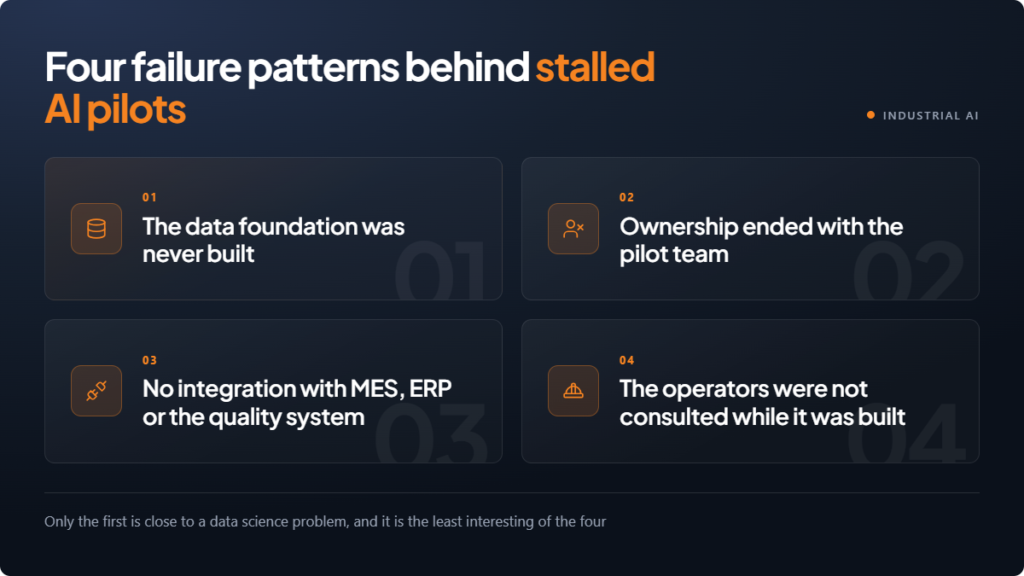
The model was trained on an export. Live data then arrived late, incomplete, and in a shape the pipeline never expected. The demo held. The line did not.
Ownership ended with the pilot team. The system kept running and stopped being consulted, which looks identical to working until somebody audits it.
Nothing was integrated with MES, ERP or the quality system. Output that does not appear where the work already happens goes unused. No operator opens a second screen while the line is moving.
The operators were never asked. So they worked around it, which is what people accountable for output do when a system does not fit the work, and training does not change it.
Only the first is close to a data science problem, and it is the least interesting of the four. All four trace back to two causes. The technique never matched the problem, or the data underneath was never ready. The model itself almost never appears in the post mortem.
What the adoption numbers actually point at
Germany’s AI adoption gets quoted at 41% across all companies. In manufacturing it sits closer to 28%. The more useful split is by size.
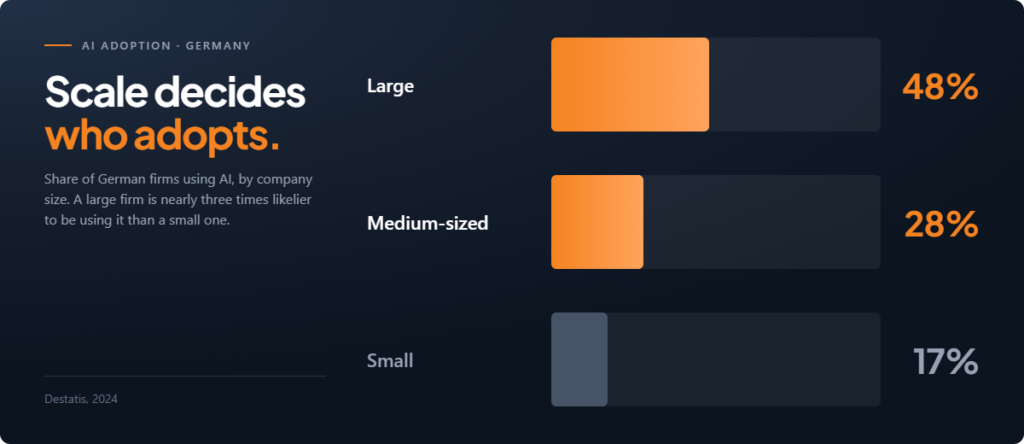
The spread by company size is wider than the spread between most sectors. That points at resourcing and procurement rather than technical difficulty, because the underlying work is the same in a plant of 200 people and a plant of 20,000.
The sector table makes the same case from the other side.
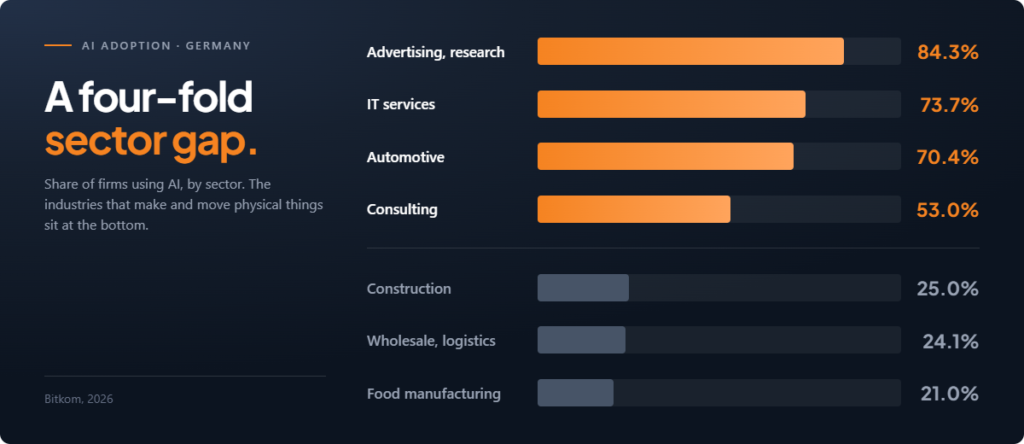
Automotive sits at 70.4%, far above the rest of manufacturing. It is also the sector that has spent thirty years buying external engineering capability, from simulation through to test and validation. Contracting outside expertise is already a normal procurement motion there, and adoption follows that habit more closely than it follows technical sophistication.
That is worth sitting with before the next build-or-buy discussion. 89% of German SMEs already buy in AI capability rather than build it, so buying it in is the majority behaviour, not the exception to explain away.
Readiness is a property of tables
Ask whether your company’s data is ready and you have a two-year programme. Ask which three tables are ready and you have an answer this afternoon.
Here is the scale we use internally. Nothing about it is proprietary, and it is worth ten minutes of your own time before you speak to any vendor, us included.
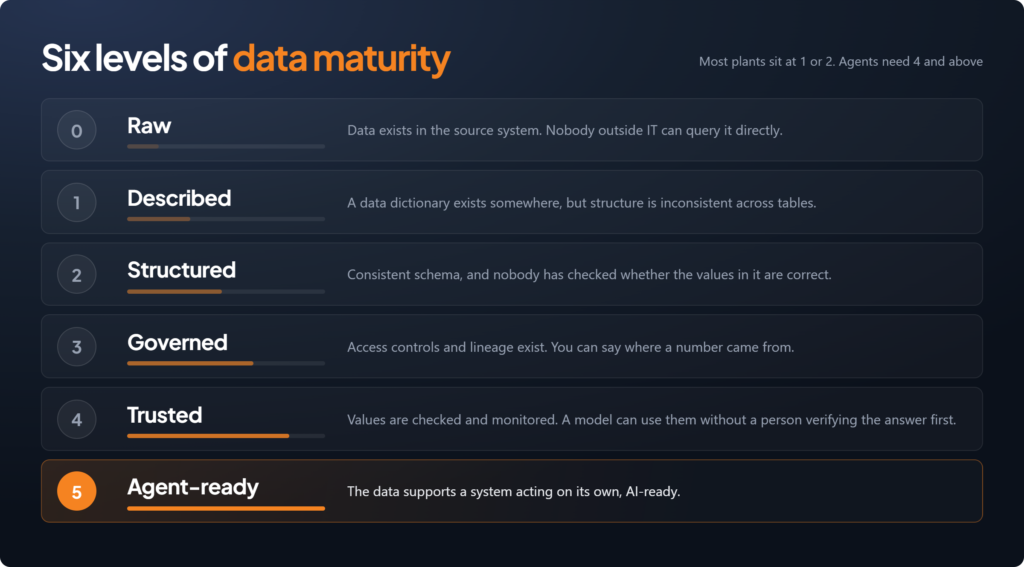
One consequence matters more than the rest. A database sitting at level 2 overall almost always contains individual tables already at level 4, and those tables are where a first use case belongs.
This also explains a statistic that usually gets read as caution. 21% of mid-sized German companies have a formal AI strategy, and 64% of the companies already using AI operate without one. Read it as sequencing instead. Most programmes select the use case first and establish the state of the data second. That order reliably produces a working demonstration and a failed deployment.
At level 0, answering one question takes six model calls and four to five minutes, and the answer still carries no guarantee. At level 4 or 5, the same question is a single call against a governed layer: seconds, repeatable, auditable.
Every hop in between is a paid call. The price of a question tracks the quality of the context around it more closely than the price of the model answering it. That is the whole economics of running a hundred use cases a day rather than five, and it is settled in the data layer, months before anyone selects a model.
The question German plants ask that outsiders miss
Foreign suppliers usually arrive prepared for data residency. EU regions, deployment inside the customer’s own cloud tenancy, no training on customer data, and most suppliers have that answer ready.
The one they get wrong is the works council. A system that watches a line changes the terms under which people work, and in Germany that is a matter for the Betriebsrat rather than a change-management afterthought. Consultation belongs in the project plan in week one. Programmes that discover it at go-live lose months, and they usually blame the technology.
The EU AI Act sits in a similar place. Most manufacturing quality and operations use cases fall outside the high-risk category, and automated visual inspection on a line is generally not high risk. The work is to assess the classification per use case and document it, rather than assume it in either direction.
On not having an in-house AI team
Most Mittelstand firms tell us they lack the in-house capability. Germany has 109,000 open IT roles and will lose 3.9 million working-age people by 2030, so the constraint is real and it is not closing.
It is also the normal case. 89% of German SMEs already use external AI solutions rather than building in house. The question is which AI implementation partner, not whether to use one.
We do not sell headcount. We work in PODs: a fixed core team that stays with you, plus capacity that scales with the phase of the work. The people who scope it are the people who deliver it.
Where to start?
We do not offer free proofs of concept. A free pilot signals that our time carries no value, gets assigned to whoever happens to be free on your side, and opens no procurement path, which is the real bottleneck in German enterprise.
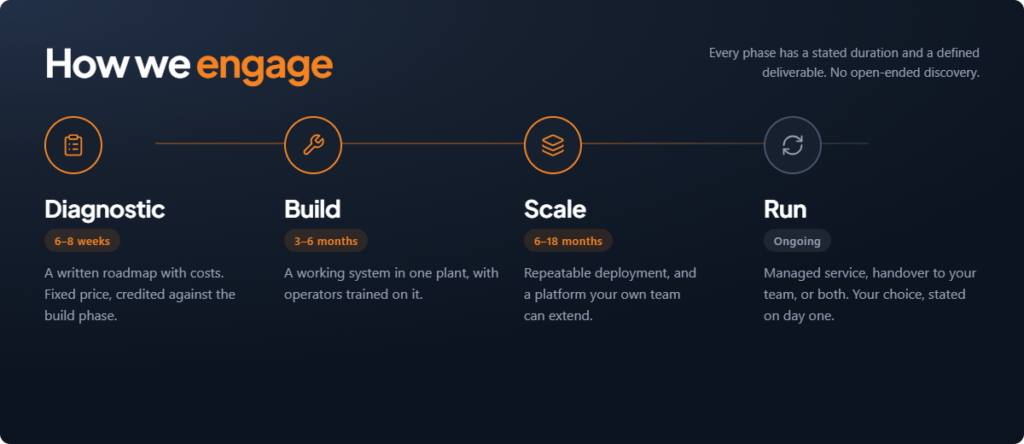
We sell a paid diagnostic instead. Six to eight weeks at a fixed price, delivered as a written assessment covering current state, data readiness, three prioritised use cases with business cases, and an implementation roadmap with costs. The fee is credited against the first build phase if you proceed within ninety days.
About Ascentt
Ascentt builds and runs enterprise AI for automotive and manufacturing companies. 20+ years in the sector, 350+ projects, 30+ models live, $2Bn+ in value created