Executive leaders no longer struggle to generate insights — they struggle to act on them. Decision Intelligence (DI) has evolved from a conceptual discipline into a practical management engine that bridges insight and action. In 2026, with generative AI, agentic systems, and digital twins in mainstream use, DI is becoming the backbone of strategic execution across industries from Swiss SMEs considering Indian market entry to global supply chain operators navigating tariff shocks and disruption.
Powered by advances in multimodal AI and multi-agent orchestration, modern DI frameworks now support real-time scenario exploration, automated policy evaluation and disruption rehearsal all governed by transparent, auditable decision models.
This article revisits Gartner’s definition of Decision Intelligence, decomposes it into an actionable formula, and shows how AI is transforming each component in 2026.
1. What Is Decision Intelligence?
A practical discipline that advances decision making by explicitly understanding and engineering how decisions are made, and how outcomes are evaluated, managed, and improved via feedback. By digitizing and modeling decisions as assets, DI bridges the insight-to-action gap to continuously improve decision quality, actions, and outcomes.
Key elements remain:
- Explicit understanding of decision logic
- Engineering of decisions into structured micro-decisions
- Digitization of decisions as reusable assets
- Feedback loops for continuous improvement
But in 2026, the definition is being stretched by AI: decisions are no longer just modeled — they are simulated, explained, and in some cases executed by AI agents under human
2. The Decision Intelligence Formula:
A practical way to operationalize definition is to treat DI as a strategic performance function:

Where:
- U = Understanding of current decision logic
- E = Engineering of decisions into micro-decisions
- MD = Digitized, modeled decision assets
- I = Insights from data and expert judgment
- C = Contextual factors (constraints, risks, stakeholders)
- F = Feedback loops for learning and adaptation
This formula is not theoretical; it’s a blueprint for building decision systems that scale with AI.
3. How AI Is Transforming Each DI Component in 2026
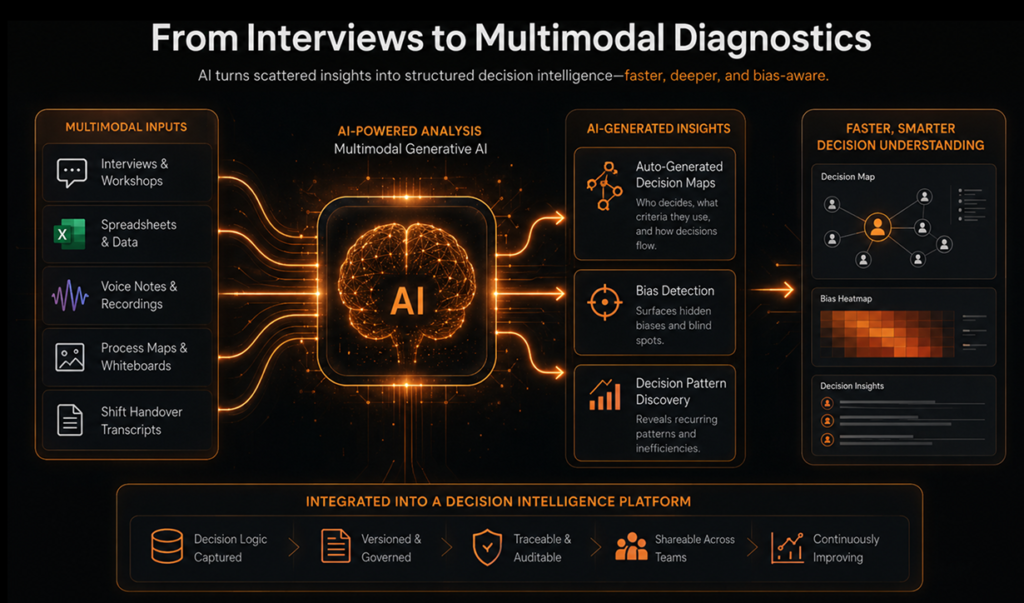
3.1 Understanding (U): From Interviews to Multimodal Diagnostics
Traditional approach: Decision audits via interviews, workshops, and bias mapping.
2026 AI-enhanced approach:
- Multimodal generative AI analyzes text, spreadsheets, voice notes, images of process maps, and even shift-handover transcripts to surface hidden decision
- AI can auto-generate decision maps that show who decides, what criteria they use, and where biases cluster far faster than manual interviews.
- Tools like Lang Chain-based orchestration frameworks integrate these insights into a Decision Intelligence Platform where decision logic is stored, versioned, and traceable.
3.2 Engineering (E): From Static Frameworks to Agentic Decision Decomposition
Traditional approach: Manual decomposition of strategic choices (e.g., market entry) into micro-decisions like channel selection, pricing, compliance.
2026 AI-enhanced approach:
- Agentic AI systems can take a high-level objective (e.g., “minimize landed cost while maintaining service and supplier diversity”) and automatically:
- Decompose it into sub-decisions
- Retrieve relevant data and constraints
- Generate and score multiple strategies
- Propose ranked options with rationale
- In supply chain planning, AI agents act as “continuous analysts” that monitor lanes, prepare scenario branches, and test them in simulation models.
3.3 Digitized Modeled Decision Assets: From Dashboards to Digital Twins
Traditional approach: Decision models as static spreadsheets or dashboards.
2026 AI-enhanced approach:
- Digital twins now serve as living environments for disruption rehearsal and policy evaluation, not just visualization.
- Multimodal AI can ingest:
- Inventory logs
- Warehouse floorplan images
- Operator audio observations
- External demand and macro indicators Then produce:
- Optimized layout concepts
- Narrative explanations of throughput gains
- Risk concentrations and counterfactual “what-if” scenarios
- Decision assets become executable models that can be re-run continuously as new data arrives.
3.4 Insights (I): From Small Data to Hybrid Expert + AI Judgment
Traditional approach: Quantitative data + expert opinions (“small data”).
2026 AI-enhanced approach:
- Generative AI synthesizes insights from heterogeneous sources (text, time series, images) to produce explanatory narratives and alternative hypotheses
- Human experts still provide domain judgment, but AI helps:
- Structure their input
- Identify contradictions
- Generate scenario narratives that reflect expert reasoning
- ABI Research reports that 94% of supply chain leaders plan to use AI for decision support, not just forecasting.
3.5 Contextual Factors (C): From PESTEL to Real-Time Context Engines
Traditional approach: PESTEL analysis, stakeholder mapping, scenario matrices.
2026 AI-enhanced approach:
- AI continuously monitors:
- Political and regulatory signals
- Tariff and trade policy changes
- Supplier instability indicators
- Transportation and labor market shifts
- These signals feed context engines that update risk profiles and constraints in real time.neuralt+1
- CFOs and CIOs now expect AI-informed models for tariff disruption modeling and supplier exposure analysis.
3.6 Feedback (F): From Quarterly Reviews to Continuous Learning Loops
Traditional approach: Quarterly KPI reviews and manual model updates.
2026 AI-enhanced approach:
- Continuous feedback loops with real-time KPIs: revenue milestones, customer acquisition costs, partner reliability, compliance adherence.
- AI agents:
- Track performance against scenarios
- Detect deviations
- Propose model refinements
- Governance frameworks now include:
- Mandatory human review gates
- Full reasoning-chain audit trails
- Rapid rollback mechanisms when models driftsimwell+1
CONCLUSION
Decision Intelligence is no longer just a framework for better decisions. It is becoming the operating model for AI-driven enterprises. As businesses navigate growing complexity and rapid change, combining human judgment with AI will become a key competitive advantage. By treating decisions as digital assets and learning from every outcome, organizations can shift from reactive decision-making to adaptive execution. The future belongs to those that turn insights into faster, smarter actions. Decision Intelligence will bridge strategy, AI, and execution to make every decision better than the last.