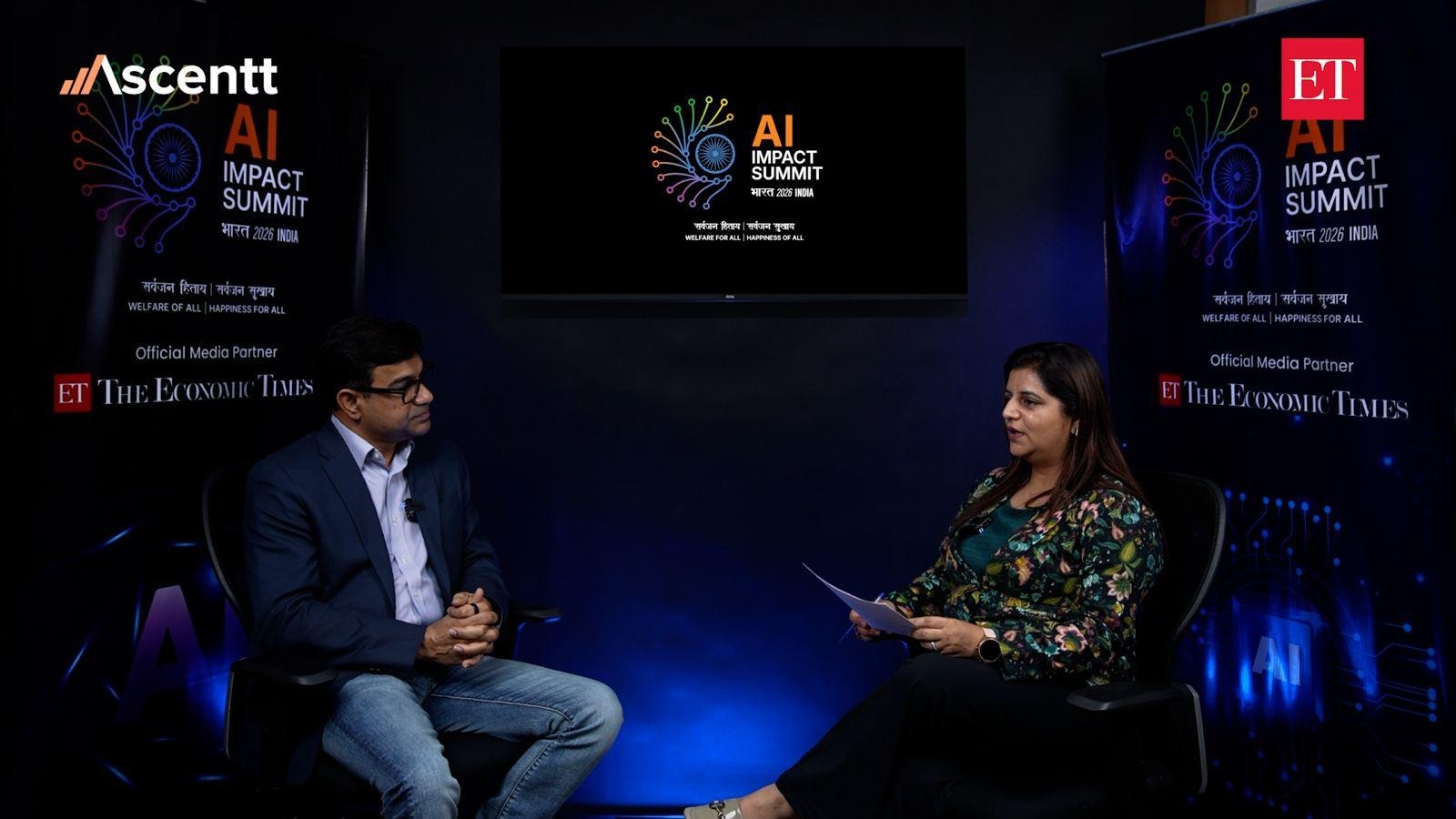
As featured in Nilesh Vyas’s conversation with Economic Times at the India AI Impact Summit 2026
Most large manufacturers have tried AI. Very few have scaled it.
The gap between a promising pilot and production-grade AI that changes how thousands of people work every single day is where most enterprise AI programs quietly die. The problem is rarely technology. It’s the approach.
At Ascentt, we’ve spent the last 15 years working with some of the world’s largest manufacturers and supply chain organizations. Here is what we’ve learned about what it actually takes to move AI from slideware to daily adoption on a global scale.
Start With the Mission, Not the Model
When we work with a Fortune 100 manufacturer, the first conversation is never about algorithms or platforms. It’s about the business mission for the next 12–18 months.
What does the leadership team need to achieve? Higher throughput? Lower inventory? Better safety? Faster service levels?
Once that is crystal clear, we map the value chain end-to-end, from shop floor to supplier network to aftersales and identify where AI can fundamentally change how work gets done, not just add another dashboard nobody looks at.
This sounds obvious. But in practice, most enterprise AI projects start with technology and work backwards to a use case. That is why so many of them stall.
The Micro-Transformation Approach
One of the most common mistakes enterprises make is trying to transform everything at once. A single massive AI programme with dozens of workstreams, a two-year roadmap, and a price tag that requires board approval before a single line of code is written.
We believe in the opposite: micro-transformations.
Find one specific, high-value problem. Build a focused, lean solution around it. Prove the value fast. Then move to the next one.
The power is in what comes next, intelligent orchestration. Each of these focused solutions doesn’t sit in isolation. They are connected through an orchestration layer that allows them to work together, share context, and compound into something that changes how the entire enterprise operates.
Think of it this way: instead of buying a bus you’ll never fully use, build the four-seater car you need. Then build the next one. And the next. Before long, you have a fleet, designed exactly for your roads.
This approach also dramatically reduces scrappage. Every AI initiative has clear business ownership, a named sponsor, and defined metric, productivity gain, cycle-time reduction, inventory turns, or service-level improvement. If we can’t measure it, we don’t build it.
AscAI: Agents Marketplace: What Enterprise AI at Scale Actually Looks Like
The clearest example of this philosophy in action is AscAI, Ascentt’s secure, enterprise-grade AI platform built around an Agents Marketplace.
Rather than one monolithic AI assistant, AscAI is a collection of business process-driven agents; modular by function, each tuned to a specific role and workflow. A demand planner agent. A quality engineer agent. A supply chain manager agent. Each one understands the vocabulary, processes, and data of the enterprise it works within.
These agents are called in and orchestrated by an agentic platform that assists decision-making across functions in natural language, in a secure environment, integrated tightly with the tools people already use every day.
The result: employees can generate technical documentation, summarize complex quality reports, draft supplier communications, navigate process manuals, and answer how-do-I questions, all without switching systems or waiting for a colleague to respond.
For one global automotive manufacturer, this platform was deployed to over 50,000 employees across engineering, manufacturing, supply chain, and corporate functions.
How did adoption reach that scale? By treating adoption as seriously as architecture. Tight integrations with existing tools, so the AI was simply there where work had already happened. Specialized personas tuned to specific workflows. Structured change management with internal champions, training, and usage tracking. And continuous improvement is based on what people were actually using.
As usage grew, the platform evolved from a capable assistant to a suite of agentic workflows, drafting root cause analysis reports, preparing supplier meeting briefs, surfacing risk signals in minutes instead of hours.
The Agentic Manufacturing Command Center
On the plant floor, the challenge is different, but the principle is the same.
Plant heads, managers, engineers and technicians track the health of their operations through KPIs like Operating Rate (OR), Overall Equipment Effectiveness (OEE) and Downtime. These revolve around the four pillars of manufacturing: Machine, Man, Material and Method.
The problem? Most plants react to problems after they happen. By the time an issue shows up in a report, the damage to throughput, quality or safety is already done. Root causes are buried in the correlation between the 4Ms and finding them takes hours of manual investigation.
Ascentt’s Agentic Manufacturing Command Center changes this.
By unifying IoT devices, MES systems and IT-OT data through an Industry 5.0-ready enterprise AI foundation, the Command Center gives plant teams forward-looking visibility and fast, actionable response. Specialized agents like LiveIQ, PreventIQ, Agentic Workbench, and RCA Agents work together to predict problems before they occur, prevent degradation in key KPIs, and when issues do happen, cut the time it takes to resolve them by up to 10x.
The impact is measurable: significant improvements in OR and Downtime reduction, saving tens of millions of dollars for global manufacturers.
The Global Supply Chain Agent: From Half a Day to Minutes
The same micro-transformation philosophy applies to supply chains.
Ascentt’s Supply Chain Agent sits on top of a customer’s existing planning and execution systems and acts as a copilot for planners and leaders across more than 10 regions globally.
Instead of clicking through 20 screens across separate tools, a planner can ask in plain language: “Where are my top five service risks for next quarter?” or “If this supplier in Region X is delayed, what are my best mitigation options? The agent ingests demand, supply, logistics and inventory data, reasons through scenarios, and presents actionable options with full explainability; then triggers the relevant workflows.
In some regions, tasks that previously took half a day across spreadsheets and systems now take minutes. Leadership gets a consistent, global view of risk and opportunity because the agent standardizes how insights are generated and shared across the organisation.
AI-Native GCCs: Rethinking Global Delivery From the Ground Up
The way global capability centers work is changing for the better.
Traditional GCCs were designed in a pre-AI era, optimized primarily for labor cost. An AI-native GCC, as Ascentt defines it, is designed from the ground up so that every activity; hiring, onboarding, engineering, operations, support is powered and accelerated by AI agents, automation and data-driven workflows.
AI is not added later. It is embedded in org design, processes, tooling, and culture from day zero.
What does this look like in practice?
A new engineer joins, and an onboarding agent sets up their environment, curates a personalized learning path and answers questions in natural language. Their manager tracks outcomes rather than micromanaging tasks. Operations teams have AI agents handling incident summaries, fix suggestions, and documentation updates automatically. Leaders get real-time visibility into delivery of health, quality, and productivity.
The numbers back up: Ascentt’s AI-native GCC model targets 3x productivity uplift over traditional setups, 50% faster onboarding, and up to 80% reduction in internal ticket resolution time.
And by locating these GCCs in Tier-2 cities like Indore, global enterprises unlock a compelling combination: strong talent pools, lower operating costs, better employee retention and a quality of life that keeps people engaged for the long term.
Where Are We on the AI Adoption Curve?
We are past the experimentation phase but not yet at full-scale industrialization.
Most large manufacturers have piloted AI in predictive maintenance, quality inspection, or generative AI for knowledge management. Far fewer have scaled it across plants and functions. The pressure to close that gap is coming from three directions simultaneously: competitiveness, geopolitical supply chain shifts, and sustainability mandates.
Over the next three to five years, AI will quietly become core infrastructure in manufacturing and supply chain, the way PLCs and ERPs did in earlier decades. The enterprises that move now, with the right approach and the right partners, will build a structural advantage that is very hard to close later.
One Piece of Advice for Manufacturing Leaders
If you are still on the fence about AI, start with one or two high-impact domains, supply chain decisioning, quality management, or digital engineering and commit to taking them all the way from pilot to scale. Not as a side experiment. With clear business ownership, a named sponsor, and change management built in from the start.
And partner with someone who is willing to live with your metrics, throughput improvement, working capital reduction, service levels, not just model metrics.
That is how you compress the adoption curve and turn AI into a real competitive advantage.
Nilesh Vyas, Founder & CEO of Ascentt, spoke with Economic Times at the India AI Impact Summit 2026.
Watch the full conversation here
To explore how Ascentt can help your organisation move from AI pilots to production-grade impact, get in touch.