In the high-stakes world of automotive manufacturing, seconds matter.
A 1% drop in Overall Run Rate (ORR) or a bottleneck in the Paint Shop can translate to millions of lost productivity. Traditionally, plant operations have relied on fragmented reports, delayed spreadsheets, and siloed views, where the Weld Shop doesn’t know what the Assembly Line is struggling with until it’s too late.
Enter the Manufacturing Command Center.
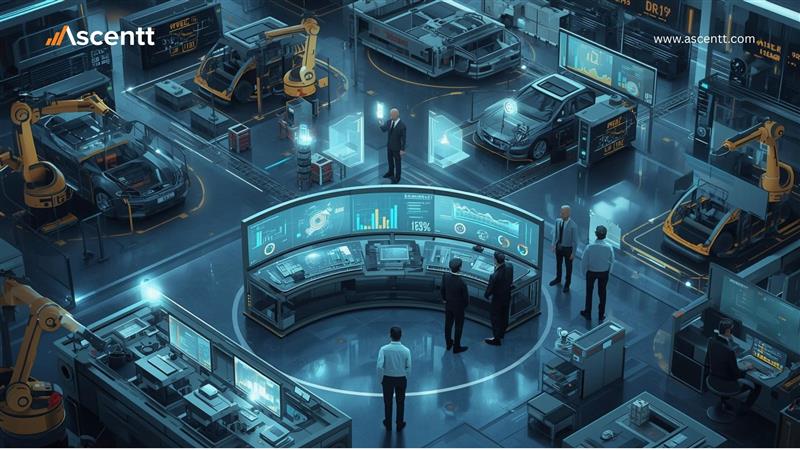
It acts as a single source of truth that evolves the concept of a “monitoring screen” into an AI-Native, Agentic Decision-Making Platform.
This isn’t just visualization; it’s about empowering every level of the plant’s hierarchy, from the technician on the floor to the executive in the boardroom—to move from reactive firefighting to proactive control.
1. The Pulse of the Plant: Total Visibility
The foundation of any command center is real-time fidelity. As seen in the dashboard, the system captures the heartbeat of the factory floor with second-by-second updates.
- End-to-End Throughput: We monitor the vehicle journey from Weld Body Side through Paint & Sealer to Final Assembly. This holistic view instantly highlights flow imbalances, for instance, if Weld is running at 87% but Final Assembly is lagging at 70%, the bottleneck is immediately visible.
- Granular Inventory Management: Unlike static reports, the inventory tiles track live buffer counts across critical zones like Yawmark, Wash-Treatment (W-T), and Offline buffers. This prevents “starvation” of the line and identifies abnormal WIP accumulation before it becomes a crisis.
- Vital Health Metrics: Key Performance Indicators (KPIs) such as ORR% (Overall Run Rate), Direct Run (DR%), and Rework Compliance are front and center. The system doesn’t just count cars; it measures the quality of the flow.
2. The AI-Native Advantage: An Agentic Approach
While the dashboard provides the “what,” our AI-Native Agentic Platform provides the “why” and the “what next.” By layering autonomous AI agents on top of this live telemetry, we transform raw data into actionable intelligence tailored to every user’s role.
Here is how the platform empowers the entire plant hierarchy:
For Plant Technicians: The "First Responder" Agent
Technicians no longer need to guess where the problem is.
- The Insight: The platform detects a micro-stoppage in the Sealer line or a temperature drift in Booth T1.
- The Action: The AI agent triggers an immediate alert on the technician’s handheld device: “Sealer flow erratic. Check the nozzle pressure. Est. Downtime Cost: 5 mins.”
- The Benefit: Reduces Mean Time to Repair (MTTR) and standardizes troubleshooting.
For Process & Quality Engineers: The "Root Cause" Agent
Engineers can move beyond correlation to causation.
- The Insight: The dashboard shows a dip in Paint DR% (93.5%) coinciding with a specific downtime event in Top Coat B.
- The Action: The AI agent analyzes historical patterns and suggests: “Correlate Top Coat B downtime with recent humidity spikes in Zone C3. Recommend adjusting curing parameters.”
- The Benefit: Proactive quality control that prevents defects rather than just counting them.
For Plant Managers: The "Flow Master" Agent
Managers get a co-pilot for line balancing and resource allocation.
- The Insight: Inventory buffers at Roll Over are critically low, threatening to starve Final Assembly.
- The Action: The AI agent simulates scenarios and advises: “Risk of line starvation in 20 minutes. Recommend diverting 10 units from Offline buffer to Main Line immediately to maintain ORR.”
- The Benefit: Maximized throughput and dynamic line balancing.
For Executives: The "Strategic" Agent
Leadership gains visibility into the P&L impact of shop floor operations.
- The Insight: Aggregated view of ORR (98.8%) and Overtime (OT) usage.
- The Action: The AI agent forecasts: “Current run rate projects 2% above weekly target. Opportunity to reduce scheduled weekend overtime shift to save OpEx.”
- The Benefit: Data-driven financial decisions and accurate delivery forecasting.
3. Enterprise Value: Why This Matters
Adopting an AI-Native Command Center drives tangible enterprise benefits:
- Unified Operational Language: Eliminates the “blame game” between departments. When Weld, Paint, and Assembly share one live dashboard, everyone works toward the same 98.8% ORR target.
- Reduced Unplanned Downtime: By monitoring distinct downtime minutes across areas like UBF, FRD, and Finesse, the system helps teams attack the “long tail” of small stops that kill productivity.
- Quality First: With Rework Compliance tracking (97.0%) and Plastics Defects (100% visible), quality isn’t an afterthought—it’s baked into the production process.
Conclusion
The future factory isn’t just automated; it’s intelligent. By combining the Live System Dashboard’s real-time visibility with an Agentic Decision-Making framework, manufacturers can finally close the loop between data and action.
It’s not just about watching the line run; it’s about knowing exactly how to make it run better, faster, and smarter.