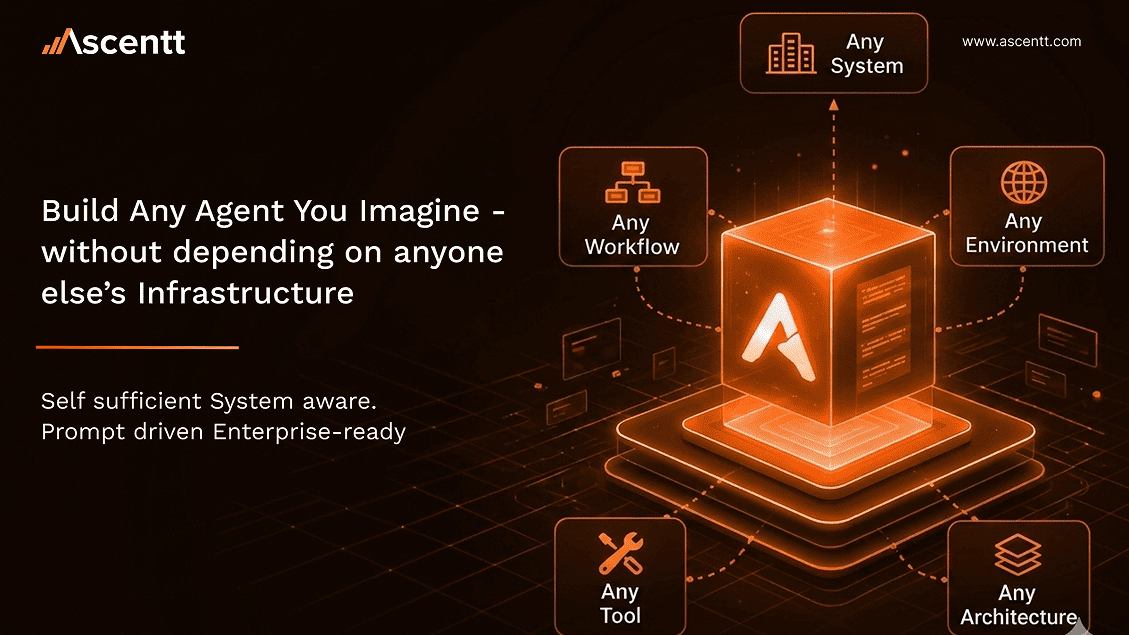
This AI agent platform that autonomously generates agents capable of operating across SaaS tools, proprietary systems, internal infrastructure, and custom enterprise environments — without relying on predefined connector ecosystems or externally maintained integrations.
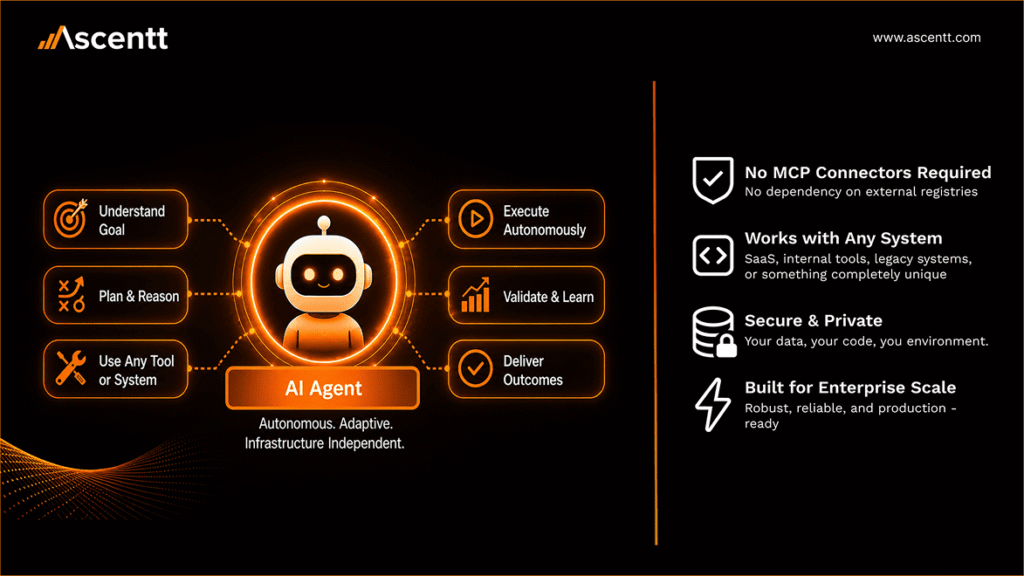
Most agent-building platforms promise flexibility, but they operate within predefined boundaries. They offer a curated catalogue of integrations, MCP connectors, and API adapters that work well — if your workflow fits inside their supported ecosystem. The problem starts when it doesn’t.
What happens when the tool you need isn’t on any MCP server? What happens when your team relies on an internal tool? A proprietary platform? A legacy system? Or a workflow that no connector marketplace supports? That’s where most agent platforms hit a wall. The moment your workflow depends on an internal tool, proprietary system, or unsupported application, those boundaries become operational bottlenecks.
Instead of enabling true autonomy, they become dependent on whether someone else has already built and maintained the integration you need. Product teams are then forced into manual workarounds, custom middleware, or lengthy connector development cycles just to automate a single workflow.
At Ascentt, we built this to remove that limitation entirely.
Rather than depending on pre-approved connectors or external MCP registries, this creates agents that can understand systems directly — including internal applications, proprietary infrastructure, and custom enterprise environments. The result is a more flexible and self-sufficient approach to agent creation, where automation capabilities are defined by your business needs and enterprise systems — not by the limitations of a third-party integration catalogue.
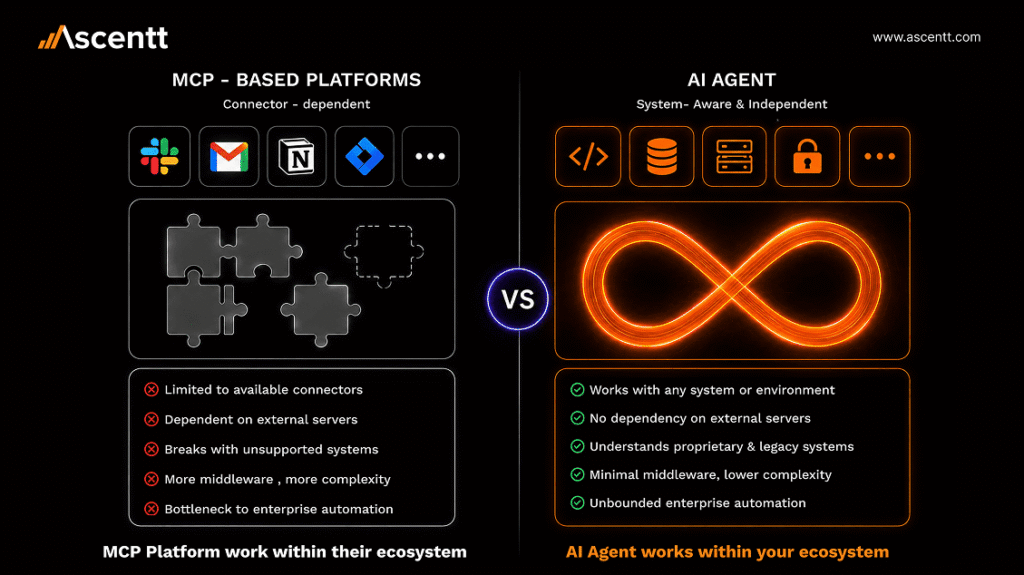
The Core Problem with Current Agent Platforms
The current generation of agent frameworks has accelerated adoption by making it easier to connect AI agents with widely used SaaS platforms such as Slack, Gmail, Notion, Jira, etc. That convenience, however, comes with important architectural trade-offs.
Most MCP-driven ecosystems operate on three core assumptions:
- The required integration already exists
- The external MCP server is available, reliable, and actively maintained
- Your workflow fits within the connector’s predefined abstraction
These assumptions begin to break down quickly in real-world enterprise environments.
Modern organizations often rely on:
- Internal applications
- Legacy systems
- Proprietary APIs
- Custom workflows
- Domain-specific tooling
- Private infrastructure that is not publicly exposed
When these systems lack MCP support, teams are forced into:
- Manual workarounds
- Custom middleware development
- Waiting for third-party integrations
- Maintaining fragile API adapters and connector layers
Over time, the agent platform itself can become the dependency bottleneck — limiting how far automation can scale across the organization.
Our Architectural Approach
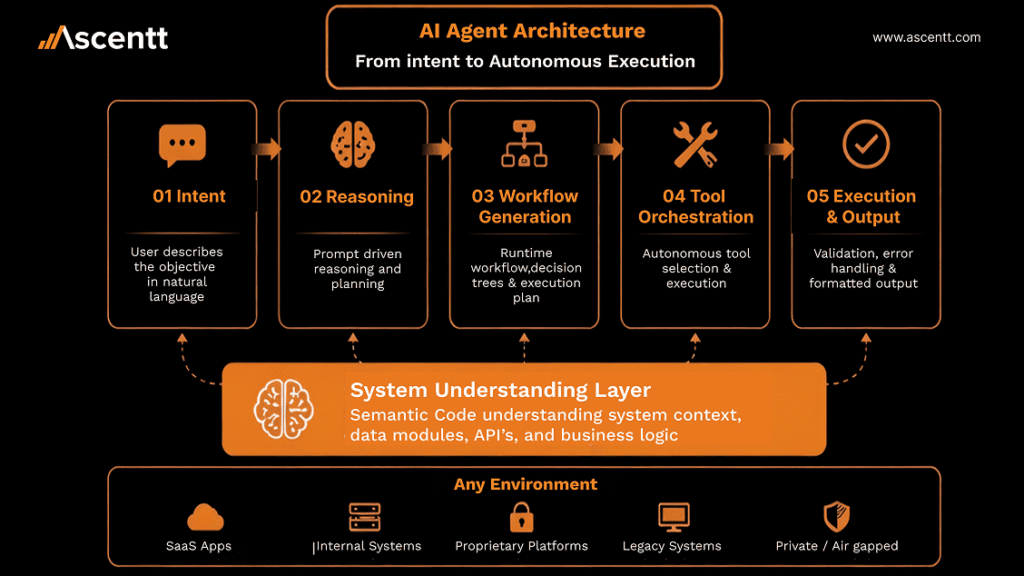
It takes a fundamentally different approach to agent creation. Instead of assembling agents from a predefined registry of integrations or relying on externally maintained connectors, it dynamically generates agents based on the user’s objective, system context, and workflow requirements.
To achieve this, it combines:
- Prompt-driven reasoning
- Runtime workflow generation
- Semantic code understanding
- Autonomous tool orchestration
This enables agents to understand, plan, and execute workflows without being constrained by a fixed integration catalogue or connector ecosystem.
The result is an agent platform that is:
- Infrastructure-independent
- Connector-agnostic
- Compatible with proprietary and internal environments
- Adaptable to virtually any software ecosystem
Rather than forcing enterprises to redesign workflows around platform limitations, it adapts itself to the systems and environments organizations already use.
Two Agent Creation Flows
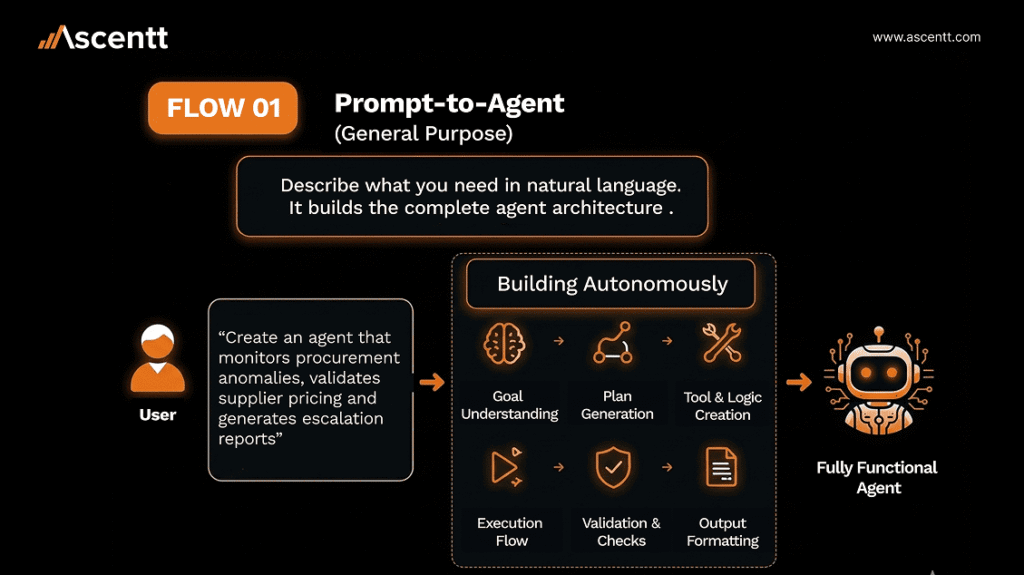
1. Prompt-to-Agent (General Purpose Automation)
It enables users to create agents simply by describing the objective in natural language.
Based on the prompt, it autonomously generates:
- Agent logic
- Workflow structure
- Decision trees
- Tool execution plans
- Validation flows
- Output formatting
- Error-handling strategies
This approach eliminates the need for:
- Predefined templates
- Hardcoded workflows
- External connector registries
Example
“Create an agent that monitors procurement anomalies, validates supplier pricing against historical benchmarks, and generates escalation reports.”
It dynamically constructs the execution architecture required to fulfill the request — including workflow orchestration, validation logic, and execution pathways — without requiring manual configuration.
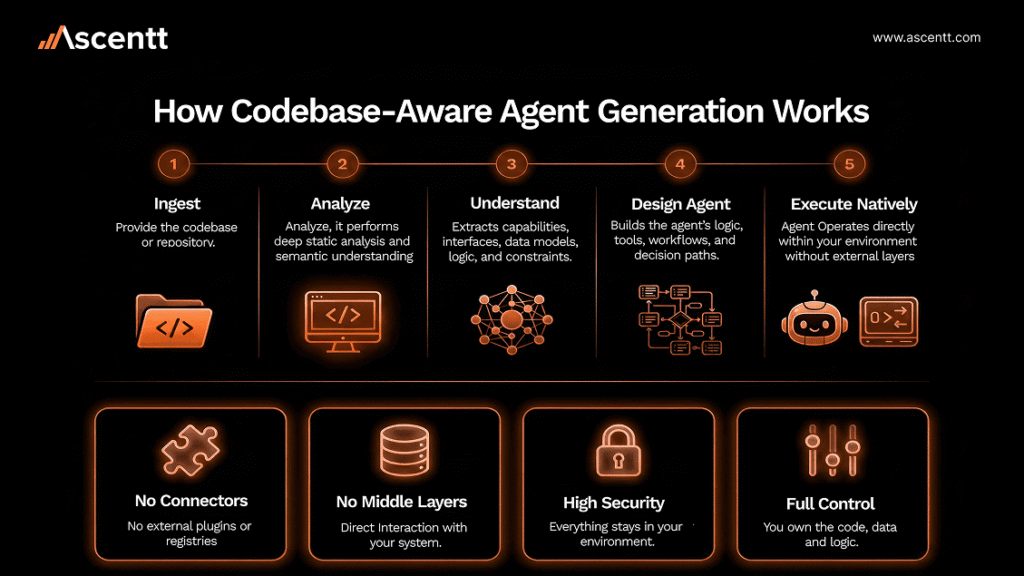
2. Codebase-Aware Agent Creation (Enterprise & Proprietary Systems)
This is the core differentiator. In addition to prompt-driven generation, it can build agents directly from an organization’s existing systems and codebases.
Users can provide:
- Git repositories
- Internal codebases
- API specifications
- SDKs and libraries
- OpenAPI documents
- Service definitions
It performs semantic analysis on the provided assets to understand:
- Application architecture
- Endpoints and interfaces
- Data models
- Authentication flows
- Business logic
- Internal dependencies
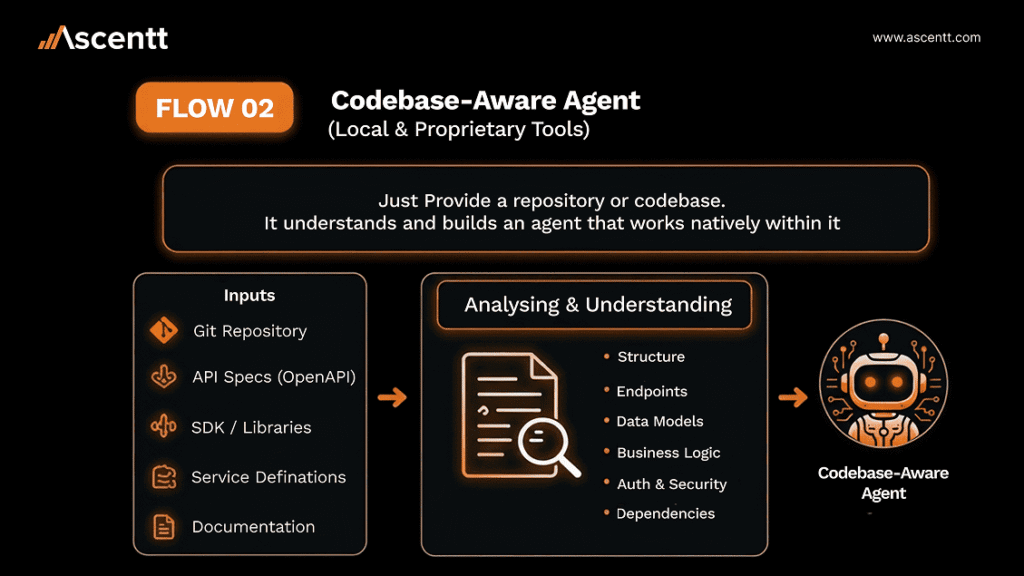
Using this understanding, it generates agents capable of operating natively within that environment. This removes the need for:
- MCP plugins
- Prebuilt connectors
- Third-party integration layers
If a system exists and its logic can be analyzed, it can generate an operational agent around it — even for proprietary, internal, or legacy enterprise platforms.
“Most agent platforms integrate with software. But this will understand the systems behind it.” Why Codebase Awareness Changes Everything
Most agent platforms are designed to understand APIs. It is designed to understand systems. That distinction is fundamental. Traditional agent platforms primarily interact with software through externally exposed interfaces such as APIs, connectors, and predefined integration layers. While effective for standardized SaaS ecosystems, this approach becomes limiting when organizations rely on internal platforms, proprietary architectures, or systems with limited external accessibility.
It goes deeper. By semantically analyzing codebases, service definitions, and application logic, it can reason directly at the implementation layer rather than depending solely on externally exposed abstractions.
This enables agents to:
- Work with internal enterprise applications
- Navigate proprietary architectures
- Operate across undocumented workflows
- Understand custom business logic
- Integrate with legacy systems
- Function within private or air-gapped environments
This capability is especially valuable for enterprises where:
- Internal tools outnumber public SaaS applications
- Security policies restrict external integrations
- Custom infrastructure is central to operations
- Legacy systems remain business-critical
Instead of requiring organizations to redesign their environments around available connectors, it adapts directly to the systems enterprises already operate/
Technical Comparison
Capability | MCP-Based Platforms | Our Platform |
Prompt-driven agent creation | ✓ | ✓ |
SaaS integrations | ✓ (where supported) | ✓ |
Internal and proprietary system support | Limited | ✓ |
Operates without MCP connectors | ✗ | ✓ |
Semantic codebase understanding | ✗ | ✓ |
Autonomous workflow generation | Partial | ✓ |
Dependency-independent execution architecture | ✗ | ✓ |
Legacy system compatibility | Limited | ✓ |
Dynamic tool logic generation | ✗ | ✓ |
While MCP-based platforms are effective for standardized integrations, their capabilities are often constrained by the availability of external connectors and predefined integration layers.
It is designed to go beyond connector-based automation by enabling agents to understand systems directly, generate workflows dynamically, and operate across proprietary, internal, and enterprise-specific environments without relying on external integration ecosystems.
Real-World Use Cases
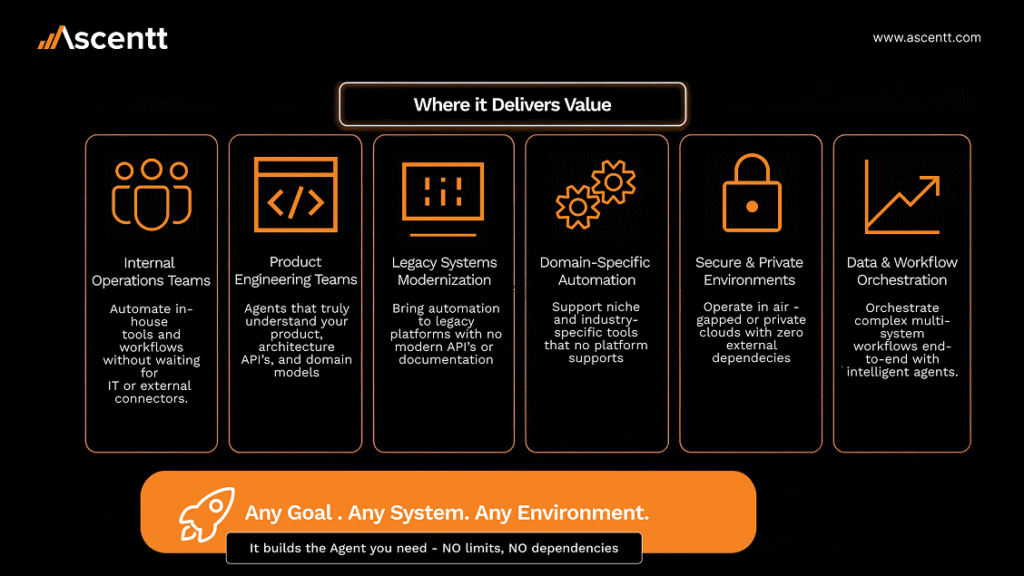
1. Enterprise Internal Operations
Organizations can use it to build agents for internal systems and operational workflows without requiring custom connector development or external integration dependencies.
This includes:
- In-house CRM platforms
- Internal approval and compliance systems
- Procurement and vendor management workflows
- HR and employee operations platforms
- Manufacturing and operational dashboards
By understanding the underlying system architecture directly, it enables automation across environments that traditional connector-based platforms often cannot support.
Example:
A manufacturing enterprise could provide it access to its internal production monitoring systems, ERP workflows, and maintenance platforms. It can then generate an agent that monitors operational anomalies, validates inventory dependencies, creates maintenance tickets, and escalates production risks automatically — without requiring custom connectors or middleware layers.
2. Product Engineering Teams
It allows engineering and product teams to generate agents that understand the organization’s own technology ecosystem rather than relying on generic third-party abstractions.
Agents can be built to work with:
- Internal architecture and services
- Proprietary APIs
- Domain-specific data models
- Custom business workflows
This enables organizations to create highly contextual and operationally aligned automation tailored to their products and infrastructure.
3. Legacy Infrastructure Modernization
Many enterprises continue to rely on mission-critical systems built on:
- Older frameworks
- Limited or outdated documentation
- Architectures without modern API layers
Traditional agent platforms often struggle in these environments due to the absence of standardized integrations.
It can semantically analyze these systems directly and generate operational agents around them, helping enterprises extend automation capabilities without needing to rebuild or replace existing infrastructure.
4. Domain-Specific Automation
In industries where tooling and workflows are highly specialized, connector ecosystems are often incomplete or non-existent.
This is especially common in sectors such as:
- Healthcare
- Manufacturing
- Supply chain and logistics
- Financial operations
- Industrial systems and operations
It removes the dependency on whether an external ecosystem supports those tools, enabling organizations to build agents around their actual operational environments rather than around available integrations.
The Strategic Shift
The next generation of AI agents will not be defined by how many integrations a platform advertises.
They will be defined by:
- How independently they can operate
- How deeply they understand enterprise systems
- How effectively they adapt to proprietary environments
- How little they depend on external infrastructure
It is built around that future.
The goal is not simply to connect agents to software, but to enable agents to understand systems, generate workflows dynamically, and operate across environments that traditional integration-based platforms cannot easily support.
When users can:
- Describe a business objective
- Provide a repository or codebase
- Expose a system architecture or service definition
and receive a fully operational, self-sufficient agent in return, that is what true agent autonomy looks like.
The Bottom Line
The future of enterprise AI agents will not be defined by how many connectors a platform supports, but by how intelligently agents can understand systems, adapt to complex environments, and operate autonomously across enterprise infrastructure.
The future of enterprise agents is not connector-first. It is system-aware, infrastructure-native, and autonomous by design.
By enabling codebase-aware, system-native, and self-sufficient agent creation, it helps organizations move beyond connector-dependent automation toward truly scalable autonomous operations.
At Ascentt, we are building it as foundational infrastructure for enterprise-grade autonomous systems — helping organizations create intelligent agent ecosystems that integrate seamlessly with internal platforms, proprietary systems, and mission-critical infrastructure, without being constrained by the limitations of third-party connector ecosystems or integration roadmaps.
Speak to our AI and enterprise automation experts to explore how it can help your organization build the next generation of autonomous enterprise agents.